Search by Keywords | Ink Cartridge Model

We use cookies to personalize content and ads, provide social media features, and analyze our traffic. By clicking Privacy Policy.
Please contact us for more information
We use cookies to personalize content and ads, provide social media features, and analyze our traffic. By clicking Privacy Policy.
Please contact us for more information
Share this article to your friends
What Is a TIJ Industrial Inkjet Cartridge? How Is It Different From an Office Cartridge?
Highlights
The first time many people encounter a TIJ industrial ink cartridge, their reaction is: “Isn’t this just a printer cartridge?” The outward appearance is similar, but industrial and office ink cartridges are designed for entirely different purposes and cannot be swapped for one another. If you’re not yet familiar with the basics of TIJ thermal inkjet technology, take a look at “What Is TIJ Thermal Inkjet Printing? A Complete Beginner's Guide” first, then come back to this breakdown of the differences.
What Is a TIJ Industrial Ink Cartridge?
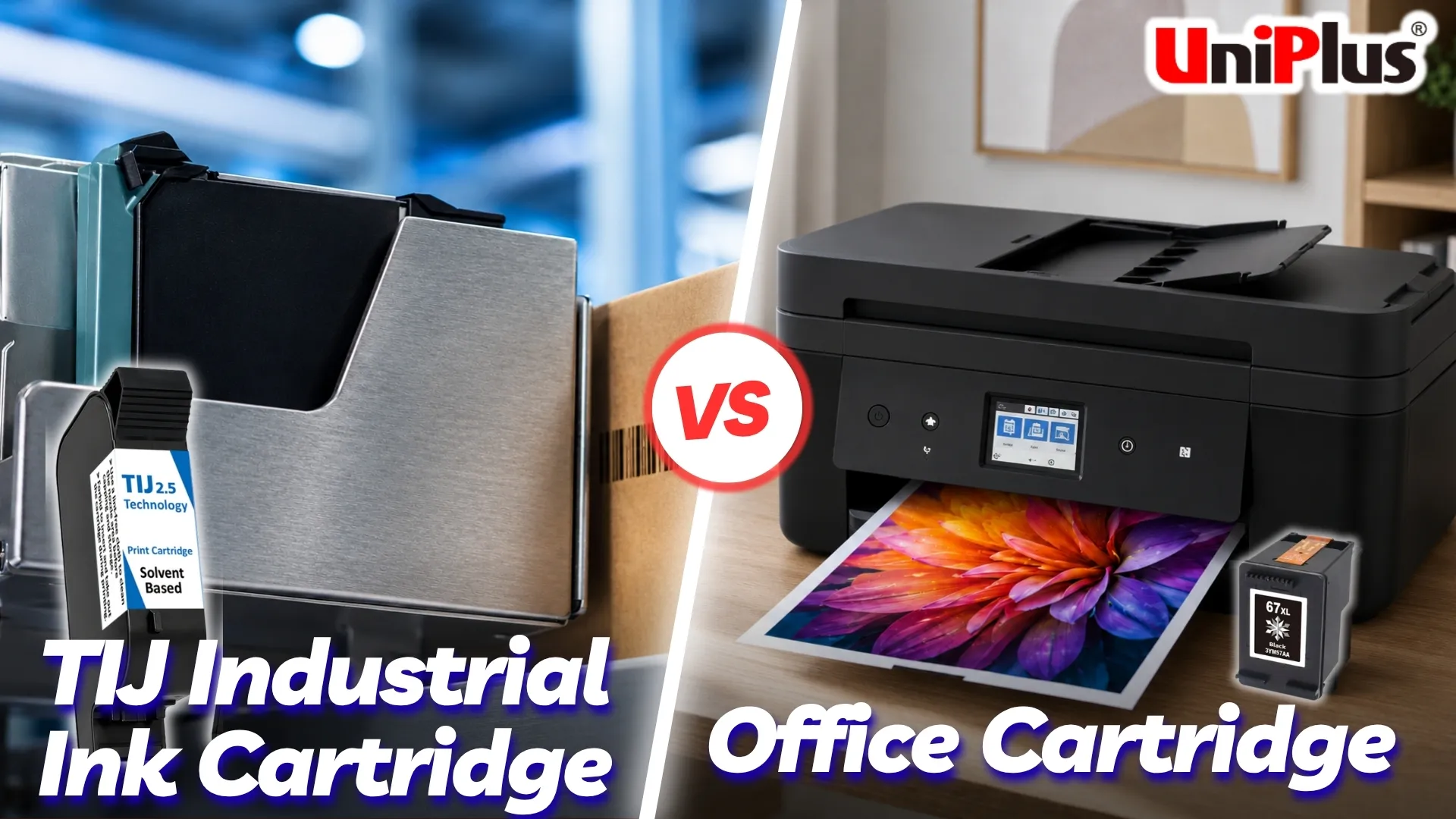
A TIJ industrial ink cartridge is a consumable built for production-line coding. Heat vaporizes the ink instantly, forming a bubble that pushes out a droplet, allowing batch numbers, expiration dates, barcodes, and similar information to be printed on cardboard, metal, plastic, glass, and other materials. It uses the same thermal inkjet principle as an office cartridge, but the ink formulation, weather resistance, and chip design are all rebuilt specifically for factory conditions rather than carried over from consumer print specs.
TIJ Industrial Cartridge vs. Office Cartridge: Spec Comparison
Place an industrial cartridge next to an office cartridge and the visible differences may be minor — but open up the spec sheet and you’ll find two completely different logics at work.
In short, an office cartridge exists to put a document on paper. An industrial cartridge exists to keep information printed reliably across a wide range of materials in a factory setting — and to survive the whole supply chain afterward. Ink viscosity, drying speed, and adhesion are engineered in different directions for each; forcing one into the other’s role won’t just produce poor print results, it can damage the printhead.
Breaking it down, these differences come down to three components: printhead, chip, and ink formulation.
Printhead
A TIJ printhead works the same way in both cases — a heating element vaporizes the ink instantly, forms a bubble, and ejects a droplet. This thermal-bubble-driven mechanism is also a common subject of engineering research (PMC). Industrial printheads are engineered for high-speed, continuous operation on production lines, while office printheads are built for the intermittent use pattern of document printing; the two differ completely in expected service life and duty cycle.
Chip
The chip on an industrial cartridge is typically used to exchange information such as cartridge identification, ink type, ink level, and compatibility verification. An office cartridge’s chip, by contrast, is usually tied to an encrypted protocol for one specific printer model and can’t be used across brands. Because the communication protocol differs, even physically inserting a cartridge into a machine won’t work if the protocol isn’t compatible — the equipment simply won’t recognize the cartridge.
Ink Formulation
This is the most visible difference. Industrial cartridges are grouped into solvent-based, water-based dye, and water-based pigment types depending on the surface — printing on aluminum foil or metal, for example, calls for a solvent-based ink with stronger adhesion. Food packaging and eggshell coding require selecting a compliant ink based on the actual contact scenario: for direct food contact, suitability for direct food contact, migration risk, and target-market regulatory requirements all need to be confirmed; for non-direct-contact outer packaging coding, packaging barrier performance and low migration risk should still be assessed. Migration risk in food-grade inks is a recognized concern in food packaging research (a food packaging chemical migration review in the Journal of Food Science (PMC) notes that low-molecular-weight ink components in paper and paperboard packaging are more prone to migration, and that this risk needs to be controlled through formulation and barrier design). An office cartridge, by comparison, is simply water-based and only needs to account for color rendering and ink absorption on paper.
If you'd like to learn more about the print head, chip, and ink inside a TIJ cartridge, take a look at What's Inside a TIJ Ink Cartridge? A Complete Guide to the Print Head, Chip, and Ink.
When You Genuinely Need an Industrial Cartridge
If your production line needs to print batch numbers, expiration dates, or barcodes on cardboard, metal parts, plastic packaging, or glass containers, an office cartridge simply isn’t up to the job. Barcode printing also has to meet technical standards for scan readability (the GS1 General Specifications set clear requirements for barcode symbol generation and quality assessment) — insufficient print resolution or unstable ink adhesion will directly affect scan traceability after the product ships.
Food and medical industries have even stricter requirements for the ink’s own regulatory compliance, which is exactly why industrial and office cartridges sit in entirely separate supply chains — office cartridges have never been validated for these applications.
Based on Uniplus’s field experience, the detail most buyers overlook at the selection stage isn’t the ink type — it’s whether the equipment’s chip communication protocol is compatible. Even with the right ink formulation, if the protocol doesn’t match, the printer still won’t recognize the cartridge. We’d recommend adding protocol compatibility to your selection checklist alongside material and ink type.
To see which industrial cartridge specifications are currently available, visit Uniplus’s TIJ 2.5 Industrial Ink Cartridge product page, which lists compatible models and suitable materials across solvent-based, water-based dye, and water-based pigment options.