
Search by Keywords | Ink Cartridge Model


The above brand names are trademarks of their respective owners.
All brand names displayed on this page are used only to show the compatibility of the respective products.
We use cookies to personalize content and ads, provide social media features, and analyze our traffic. By clicking Privacy Policy.
Please contact us for more information
Share this article to your friends
TIJ Ink Cartridges for Glass Printing: From Technology to Selection Guide
Glass is a non-absorbent material widely used in industrial packaging for its high transparency, non-porous surface, and chemical stability — with primary applications in food, beverage, pharmaceutical, cosmetic, and building material industries. These same properties create three key inkjet printing challenges: poor ink adhesion on smooth surfaces, difficulty printing on curved forms, and high durability requirements for long-term legibility. This article answers the most common questions about glass inkjet coding and explains how UniPlus TIJ solvent ink cartridges address each challenge.
What Is TIJ Thermal Inkjet Technology? How Does It Differ from CIJ?
TIJ (Thermal Inkjet) is an industrial inkjet coding technology that integrates a heating element and ink within a single cartridge. An electrical current heats the element, instantly vaporizing the ink to form a bubble that propels precise ink droplets onto the substrate surface. Cartridges are ready to use and simply replaced when empty — no solvent line flushing required — making maintenance costs significantly lower than CIJ (Continuous Inkjet) systems, which require regular solvent circuit cleaning. For small-to-medium production lines or environments with frequent product changeovers, TIJ is the more cost-effective choice.
For a detailed TIJ overview, see — What Is TIJ Thermal Inkjet Printing? A Complete Beginner's Guide
Glass Inkjet Coding: Technical Q&A
Why is inkjet coding on glass especially challenging?
Glass inkjet coding presents three main technical challenges:
Which TIJ ink cartridge should I choose for glass coding?
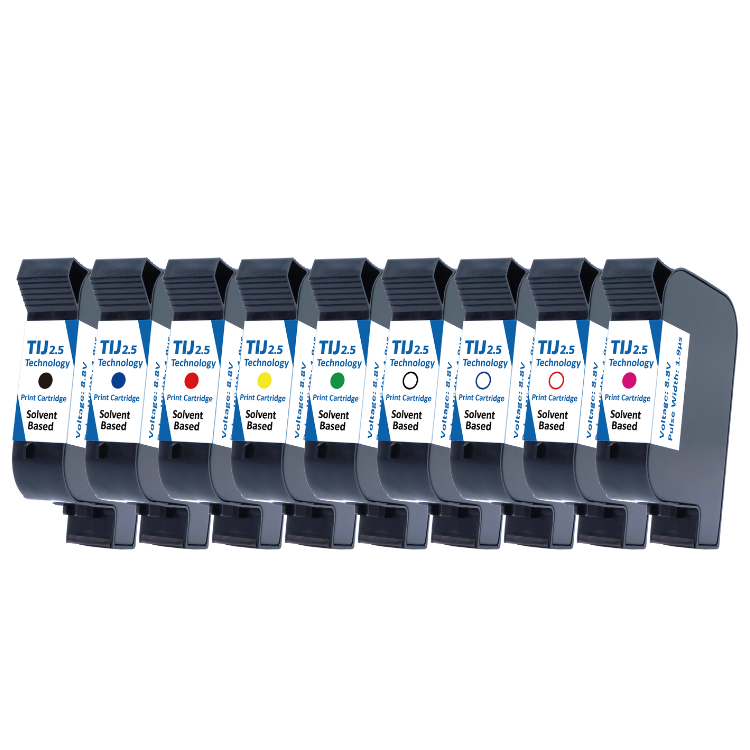
Solvent-based TIJ ink cartridges are recommended for glass applications. Solvent ink offers strong adhesion, fast drying, water resistance, and abrasion resistance — making it well-suited for non-absorbent substrates like glass. UniPlus solvent TIJ cartridges are also available in food-grade magenta, food-grade blue, and UV-fluorescent invisible ink options.
4-Step Guide to Selecting the Right TIJ Ink Cartridge for Glass
Glass Printing Demo: Handheld TIJ Inkjet Printer on Glass Surface
UniPlus TIJ Solvent Ink Cartridge: Product Q&A
What are the core advantages of UniPlus solvent ink cartridges for glass printing?
What is the maximum print height for UniPlus solvent ink cartridges?
With a half-inch (0.5") cartridge, the maximum single-head print height is 12.7 mm. With a one-inch (1") cartridge, the maximum single-head print height is 25.4 mm. For greater print heights, multi-head configurations can be combined to meet different production line requirements.
Is an invisible ink option available for glass printing?
Yes. UniPlus offers solvent-based UV-fluorescent invisible ink cartridges that are not visible under normal lighting, but become visible when exposed to a UV (ultraviolet) light. These are ideal for anti-counterfeiting marks or applications where visible coding would affect the appearance of high-end glass packaging (such as luxury goods, pharmaceuticals, and premium beverages).
Are UniPlus ink cartridges compatible with encrypted TIJ printers?
UniPlus ink cartridges are fully compatible with non-encrypted TIJ printers. For customers using encrypted printer models, please refer to the following pages to confirm compatibility:
Need Help with Glass Inkjet Coding? Contact UniPlus Today
UniPlus has over 20 years of industrial ink cartridge manufacturing and R&D experience. We provide customized ink formulations and product selection guidance based on your glass substrate dimensions, production line speed, regulatory requirements, and ink color needs. Click below to get in touch with our technical team.