
Search by Keywords | Ink Cartridge Model
The above brand names are trademarks of their respective owners.
All brand names displayed on this page are used only to show the compatibility of the respective products.
We use cookies to personalize content and ads, provide social media features, and analyze our traffic. By clicking Privacy Policy.
Please contact us for more information
Share this article to your friends
Highlights
High-adhesion TIJ coding on PE and PP bottles means using thermal inkjet (TIJ) printheads to print batch numbers and date information directly onto polyethylene (PE) and polypropylene (PP) bottles. The goal is a code that stays legible for as long as the consumer uses the product. PE and PP are commonly used for shampoo, body wash, lotion and hand soap bottles.
Among the specialty applications covered in the Complete TIJ Printing Applications for Manufacturing, Logistics, E-Commerce and Specialty Industries, PE and PP bottles have some of the stricter adhesion requirements. When personal care brands adopt TIJ, the problem is rarely whether the code prints. The problem is whether it is still legible after long exposure to moisture, cleaning agents and repeated rubbing.
Why Do Codes Rub Off PE and PP Bottles?
PE and PP have low surface energy, which makes them common hard-to-adhere plastic substrates. Surface energy describes how readily a material surface lets a liquid wet and spread across it. When a substrate's surface energy is low, poor wetting can limit ink spreading and interfacial contact with the substrate, and the dried ink is easier to peel off. How well the ink actually wets the surface also depends on the ink's surface tension and on the condition of the bottle surface.
Personal care bottles are difficult for two reasons:
The bottle-making process can also make results vary. Two potential factors are:
Coding Content and Labeling Rules for Personal Care Bottles
In Taiwan, general cleansing products such as shampoo and body wash are regulated as cosmetics. Under Article 7 of the Cosmetic Hygiene and Safety Act, the outer packaging or container of a cosmetic must show a batch number and one of three date combinations:
The format and method of labeling follow the labeling regulations for cosmetic outer packaging, containers, labels and leaflets (in Chinese) issued by Taiwan's Ministry of Health and Welfare, in force since July 1, 2021. Two points relate directly to coding:
Actual labeling still depends on each product's packaging, and later amendments follow the most recent announcements from Taiwan FDA.
For products exported to the EU, Article 19 of the EU Cosmetics Regulation (EC) No 1223/2009 sets date and batch requirements that differ from Taiwan's:
Requirements for content, position and exceptions differ between markets. The brand's regulatory owner should confirm what goes on the bottle for each market during packaging design.
Many shampoo and body wash bottles have no outer carton, so the bottle is the main labeling surface. Once a code rubs off during use, consumers and retailers can no longer identify the batch on their own, and traceability relies more heavily on the brand's internal production records. This is why bottle adhesion should be judged over the product's period of use.
Matching Surface Treatment With TIJ Ink
Adhesion on PE and PP bottles depends on both the bottle surface and the ink formulation, so the two need to be evaluated together. Adjusting only one of them may not solve an adhesion problem.
Corona, Flame and Plasma Treatment
Corona treatment is a pretreatment that raises the surface energy of plastics to improve adhesion. It is most common on films. Three-dimensional containers such as bottles and jars are often treated with flame or plasma instead. The effect depends on the material and the treatment energy, and may decline during storage at a rate that varies with the material and storage conditions.
The level of treatment can be checked by measuring wetting tension. ASTM D2578 is a test method for the wetting tension of PE and PP films. Because it was written for films, it can only serve as a reference for its principle on curved bottle surfaces, not as a claim that measurement was done to the standard. The standard itself also notes that wetting tension is not a complete measure of ink adhesion, so actual print testing is still needed.
Choosing TIJ Ink
PE and PP are low-surface-energy, non-porous substrates, so the ink needs to suit their surface characteristics. Solvent-based TIJ ink is a common choice, but actual adhesion still depends on the formulation, bottle resin, surface treatment and contamination. Even with the same HDPE or PP grade, different production lots should be evaluated for potential variations in adhesion and rub resistance. Suitability cannot be judged from the material name alone.
When evaluating ink, check four points against real conditions:
For the positioning and suitable substrates of each Uniplus cartridge type, see the Uniplus TIJ industrial ink cartridge page.
TIJ Adhesion Testing on PE and PP Bottles
Before adopting TIJ coding on PE or PP bottles, always run adhesion tests on actual production bottles. The purpose is to confirm how durable the code is under real use conditions, not just how it looks right after printing.
Five Test Areas
A single tape peel or solvent wipe cannot represent bathroom humidity, surfactant contact, repeated squeezing and long-term storage. A complete test program should cover five areas:
Reference Methods for Testing
Tape peel testing can follow the principle of ASTM D3359. That standard mainly covers coatings on metal substrates, so it cannot be treated as a complete validation standard for codes on plastic bottles. Wet rub, product contact, squeeze and aging tests should be defined separately to match the customer's actual use conditions.
Quick Screening vs. Formal Validation
A quick screen is not validation. Results change with the tape type, solvent, rubbing force and environment. If a customer requires formal data, the test method and pass criteria should be agreed in writing beforehand. For example, the agreement might specify how many rubs the code must survive while staying legible and keeping its barcode readable. Passing a single tape test does not support a claim that the code will last for the product's entire period of use.
Testing With Production Bottles and Real Product
Test on production bottles. If the bottle has been corona treated or coated, results will differ noticeably. Sample bottles can be used for initial screening but cannot replace formal validation on production bottles. Use your own product as the wiping liquid wherever possible. Shampoo and lotion contain different proportions of surfactants and oils, and they affect the ink layer differently.
Record the tape type, wiping solvent, rub count and force, drying time, ambient temperature and humidity, and bottle lot number for every test. Without these, the next comparison means little.
Because surface treatment effects can change during storage, Uniplus recommends testing bottles at different points after they arrive, for example on delivery and again after several weeks in storage. This checks whether adhesion drops noticeably under the chosen storage conditions.
TIJ Printhead Setup on Bottle Lines
Coding stability on bottles is closely tied to where the printhead sits on the line.
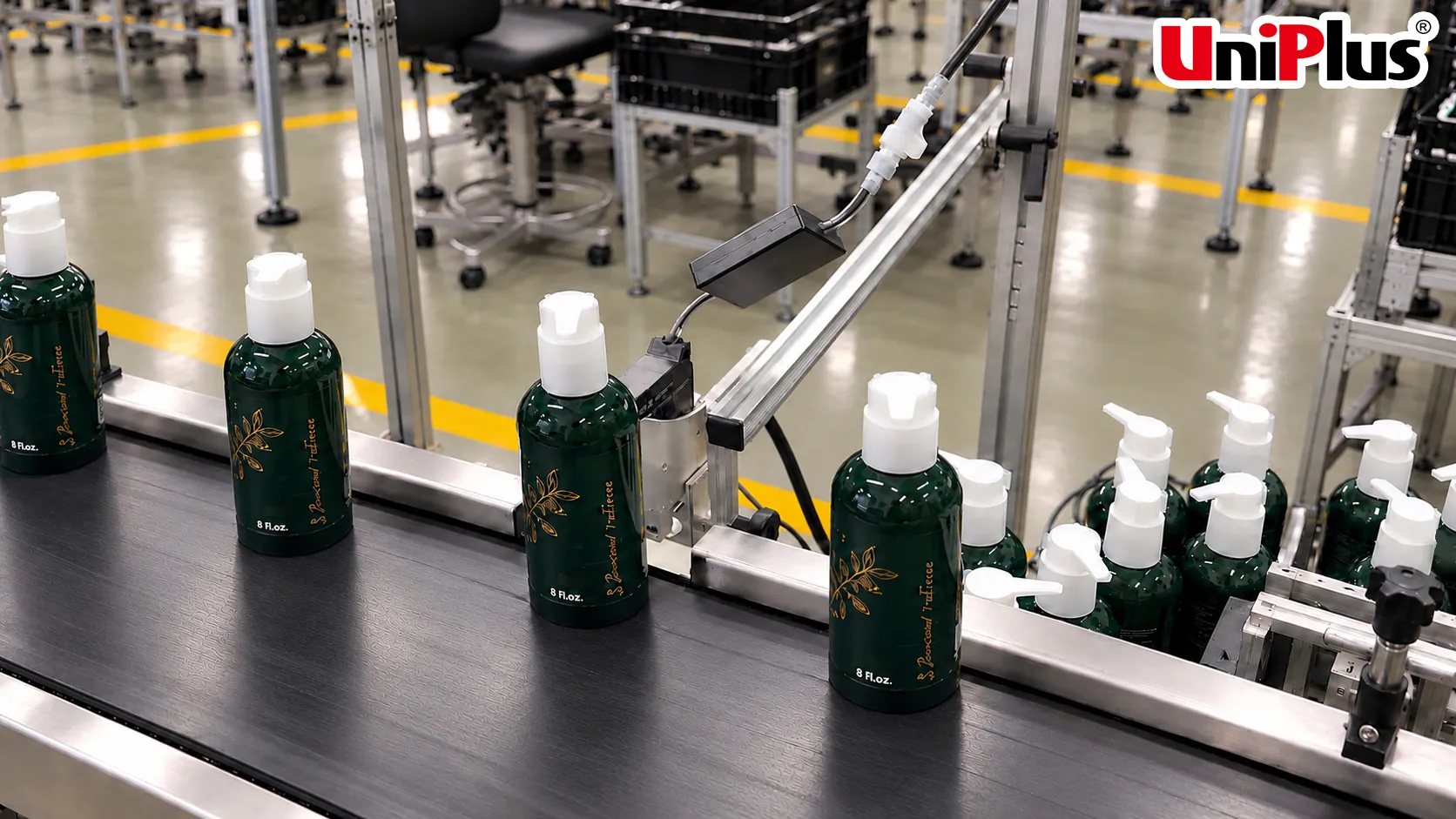
Coding Before or After Filling
Two approaches are used for coding timing:
Curved Bottles and Throw Distance
Throw distance, the distance from the nozzles to the substrate surface, is generally short for TIJ. The allowable distance depends on the printhead, ink, resolution and speed. The more curved the surface, the greater the difference in distance between the top and bottom of the code, and edge characters tend to thicken or blur. Bottle wobble and printhead angle also affect the result. On round and oval bottles, place the code on a flatter area or reduce the code height.
Batch and date information usually takes two to three lines of text. A half-inch cartridge with a nominal print height of 12.7 mm is usually enough, but confirm the effective height for each model. When more lines are needed in the same position, consider a one-inch cartridge or a multi-printhead setup, and confirm the controller's capability and font layout at the same time.
For products sold in Taiwan, the printed batch and date information must also comply with applicable cosmetic labeling requirements, including minimum character dimensions. When selecting a half-inch or one-inch TIJ cartridge, verify not only the available print height and number of lines, but also the final character size and legibility required by the target market.
Drying Time and Downstream Contact Points
Any contact before the code is fully dry can cause smearing. For a rough estimate, divide the distance from the printhead to the next contact point (guide rail, labeler, shrink sleeve, case packer) by the line speed. The result is the drying time available under ideal conditions. This estimate does not account for acceleration, bottle rotation or safety margin, so whether the ink dries in time at real line speed must still be checked on site.
Changeover Stops and Decap Time
Personal care brands run many SKUs, so changeover stops are routine. Decap time is the length of time nozzles can be exposed to air after printing stops and still recover normal ink ejection. It varies with the environment and stop conditions. After a longer stop, follow the recovery procedure for the specific ink and equipment, such as cleaning or spitting, before resuming production. This helps reduce the risk of missing dots or broken characters on the first few bottles.
TIJ Coding Differences Between PET and PE/PP Bottles
Personal care packaging is not limited to PE and PP. Some clear shampoo and toner bottles use PET, and each material has different coding considerations:
Adhesion and fast-drying properties on PET bottles are covered separately in PET Bottle TIJ Coding: Adhesion and Fast-Drying Properties. If your brand also uses glass, acrylic or metal tube packaging, coding conditions differ again; see TIJ Coding on Glass, Acrylic and Metal Tube Packaging for Cosmetic Brands.
Evaluation Checklist Before Bottle Coding
Confirming the following items before adoption helps avoid discovering missing or smeared codes after production starts:
Beyond bottle codes, barcodes on shipping cartons follow GS1 size and quality rules; see High-Speed TIJ Barcode Coding on Logistics Carton Lines. Substrates and evaluation points for other industries are covered in the complete TIJ printing applications guide.
Uniplus TIJ Cartridges for PE and PP Bottles
Uniplus has manufactured thermal inkjet cartridges since 2002. Its industrial cartridges cover three ink types, solvent-based, water-based dye and water-based pigment, in half-inch (12.7 mm) and one-inch (25.4 mm) formats. For HDPE, LDPE and PP personal care bottles, solvent-based TIJ inks designed for non-porous substrates are the first option to evaluate. Actual adhesion, drying speed and resistance to product contents must still be confirmed by testing with the specific ink model, production bottle surface and use conditions. For compatible printers and specifications of each model, see the TIJ industrial ink cartridge page.
Uniplus provides compatibility verification services. If your equipment uses encrypted chips, share the printer model during discussions and we will help evaluate feasible options.
When evaluating bottle coding needs, we ask customers for four inputs: production bottle samples, print content, line speed and operating environment. With these, adhesion and drying tests can be arranged under conditions close to actual production. Contact Uniplus to discuss your bottle coding conditions.