
Search by Keywords | Ink Cartridge Model
The above brand names are trademarks of their respective owners.
All brand names displayed on this page are used only to show the compatibility of the respective products.
We use cookies to personalize content and ads, provide social media features, and analyze our traffic. By clicking Privacy Policy.
Please contact us for more information
Share this article to your friends
Complete TIJ Printing Applications for Manufacturing, Logistics, E-Commerce and Specialty IndustriesHighlights
TIJ (Thermal Inkjet) is a non-contact printing technology that uses heat-generated bubbles to fire ink onto a surface. It prints batch codes, expiry dates, serial numbers, barcodes and 2D codes.
The same technology appears on a PCB line in an electronics plant, on a carton conveyor in a distribution centre, and on foil pouches at a cosmetic contract manufacturer.
Machine architecture is only part of what separates one application from another. Four variables determine suitability: substrate, line speed, environment and code specification.
This article organises real TIJ applications into three domains and fifteen production scenarios, covering the printing conditions each one presents and how ink selection follows from them. For the underlying technology, see our introduction to TIJ thermal inkjet printing.
Three Domains That Drive Industrial Coding Demand
From a procurement perspective, industrial coding demand falls into three domains, each with a different driver:
All three share one thing: coding is rarely the main event on a production line, yet it is one of the most common points of failure. Smeared codes, failed scans, codes wiped off by oil, and downtime at every changeover all hit shipping directly.
What Materials Can TIJ Print On?
TIJ prints on both porous and non-porous materials. The ink formulation primarily determines substrate compatibility, though printhead conditions, throw distance (the gap between the printhead and the substrate surface) and equipment parameters also limit what is feasible. Choose the wrong ink and no amount of equipment quality will make the code hold.
plastics, metal, glass, foil
cartons, paper, labels
paper, cartons, wood
The table lists characteristics that formulations in each class commonly target, not inherent properties of the class. Two things to keep in mind when reading it:
In practice, the materials that cause trouble are the ones sitting between the two categories. Poly-coated cartons, varnished cartons and moisture-barrier woven sacks look like paper but have had their absorbency sealed off by the coating, so they need to be evaluated as non-porous.
When we help customers with selection, we usually ask them to send a small piece of the actual packaging material for a trial print. The surface treatment behind the same product name can differ more between suppliers than people expect.
Manufacturing: TIJ Printing for Product and Component Traceability
Manufacturing shares a common set of conditions: codes are small, information density is high, and downstream processing is demanding. After coding, parts still face handling, washing, assembly or high-temperature steps, and the code has to survive until shipment.
High-Resolution ID Code Printing on PCB Boards for Electronics Manufacturers
Component layout, solder mask zones and available board space all constrain the printable area on a PCB. Within that limited area you may need a board number, a batch code, an orientation mark and sometimes a 2D code. Three things to confirm first:
For the full treatment of this application, including how to handle surface zoning and the code verification workflow, see High-Resolution TIJ ID Code Printing on PCB Boards for Electronics Manufacturers.
High-Speed Batch Coding on Small-Pack Hardware and Fastener Packaging
Screws, nuts and fasteners come in small pack units, and on a high-speed packaging line the gaps between packs are short and the cycle is tight. Beyond ink compatibility, these lines tend to get stuck on trigger timing and changeover efficiency:
ESD-Safe Serial Number Coding on Electronic Component Trays and Anti-Static Bags
Anti-static bags and component trays package ESD-sensitive items. TIJ is a non-contact process, so the printhead never touches the packaging surface. Non-contact does not mean the equipment meets the requirements of an ESD Protected Area (EPA). Evaluate on three levels:
Oil- and Abrasion-Resistant Traceability Code Printing on Automotive Metal Parts
Automotive supply chains generally carry long-term traceability requirements, and individual OEMs set their own identification specifications. The code is often printed directly on the metal part rather than on outer packaging. Three points:
Serial Traceability Coding on Solar Panel and Lithium Battery Packaging
Serial numbers on solar modules and lithium batteries support recall and product-history queries throughout the warranty period, so the marking generally needs to be durable and traceable.
Logistics and E-Commerce: TIJ Printing on Conveyor Lines and Shipping Environments
In logistics the code is read by machines, not by people. Symbol dimensions, quiet zones and print quality are all constrained by standards, leaving far less room to adjust than on the manufacturing side.
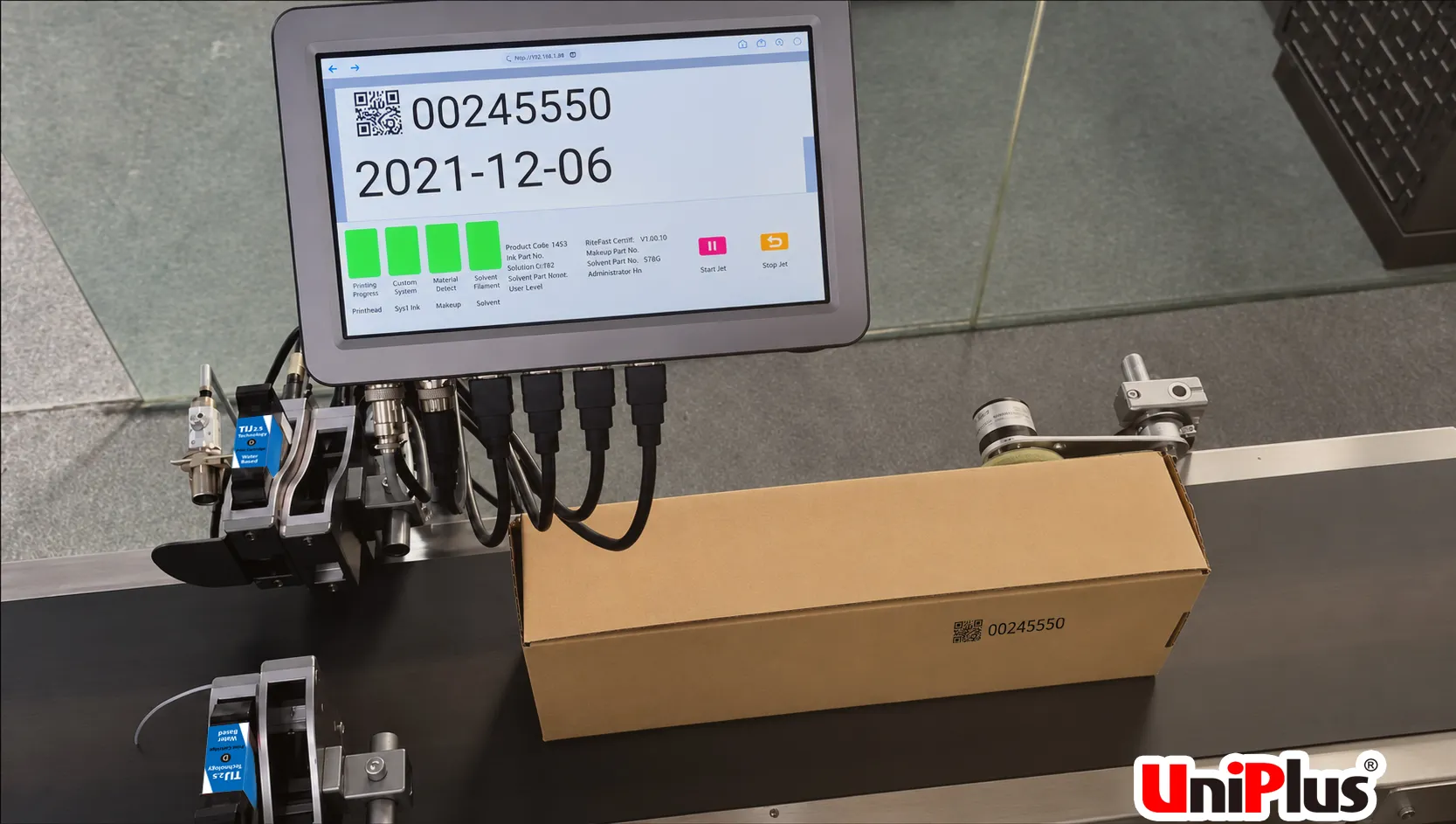
High-Speed Barcode Coding on Logistics Carton Lines
Uncoated corrugated cartons are usually well absorbent, and water-based TIJ is a common first choice; cartons with poly coating, varnish or a special coating need their ink compatibility re-confirmed. Beyond substrate and ink, logistics barcodes are also governed by GS1 requirements for dimensions, print quality and quiet zones, meaning the blank margins around a barcode. According to the GS1 General Specifications, bar height for ITF-14 and GS1-128 in general distribution scanning follows three tiers:
Two things are easy to get wrong here:
For a full comparison of barcode dimensions against print height, see our half-inch versus one-inch industrial cartridge comparison, and GS1 UK's guidance on ITF-14 sizing.
ISPM-15 Compliant Export Mark Coding on Wooden Pallets and Crates
Wooden pallets and crates used for export must comply with the IPPC ISPM 15 standard. Separate the question of authorisation from the question of printing technology:
Stable Coding on Cold Chain Packaging in Temperature-Controlled Logistics
Cold chain adds temperature, humidity and condensation control on top of the line-speed conditions already present.
Variable Order Number Coding on E-Commerce Shipping Cartons
E-commerce shipping is defined by the fact that no two cartons carry the same content: order number, pick location and shipping batch all change carton by carton.
Specialty Industries: TIJ Printing on Difficult Substrates and Security Codes
What these applications share is a difficult substrate, a low tolerance for visible marking, or the need for an extra security layer. The code has to be clearly legible without disrupting the packaging design.
Weather-Resistant Coding on Seed and Pesticide Bags for Agricultural Packaging
Seed and pesticide bags are mostly PE woven sacks, foil laminate pouches or plastic bottles, and they sit exposed in open storage or field environments for months.
Coding on Glass, Acrylic and Metal Tube Packaging for Cosmetic Brands
Glass, acrylic and aluminium tubes are all non-porous, and most of them are curved.
Wide-Format Coding on Plastic Film Packaging for Tissue and Paper Towel Manufacturers
Tissue and paper towel outer packaging is large-area plastic film, and the printed content usually calls for larger characters.
Small-Batch Multi-SKU Coding on Sheet Mask Foil Pouches for Beauty OEM Manufacturers
Contract manufacturers run several brands and several formats on the same line in a single day. In our experience of customer enquiries, changeover downtime sits alongside cartridge cost as a common evaluation criterion.
High-Adhesion Coding on PE and PP Bottles for Personal Care Manufacturers
PE and PP have low surface energy and are among the hardest plastic substrates to print on. Shampoo, body wash and lotion bottles also meet water and surfactants in use, so the risk of the code being rubbed off is higher than with ordinary packaging. Adhesion testing is mandatory before implementation:
Invisible Ink Anti-Counterfeit Coding for Lottery Ticket Manufacturers
Beyond the visible serial number or barcode, lottery tickets, vouchers and gift certificates can also carry an authentication feature that is difficult to detect under normal lighting. Invisible ink can serve as one layer of that authentication, developing under a specified light source or inspection condition.
Four Selection Variables Common to Every Industry
Fifteen scenarios look very different from one another, yet they all come back to the same four variables. Pin these down and the conversation shifts from "which machine is better" to "which specification combination fits these site conditions".
Environmental conditions are the most frequently overlooked of the four. Equipment evaluation usually happens in a room-temperature office, and only after installation does high humidity, dust or frequent stoppage reveal completely different behaviour. For the full selection logic, see our TIJ specification selection guide, and for a breakdown by sector, our overview of TIJ application scenarios.
Site Evaluation Checklist Before Implementation
Gathering the following before approaching a supplier noticeably reduces the number of quotation and sample rounds.
In our experience, packaging samples, print content and line conditions are enough for an initial ink and specification recommendation. Getting the trial print right on the first attempt needs the environment, downstream processing, equipment details and volume figures as well.
What Uniplus Supplies in TIJ Cartridges
Once those four variables are confirmed, the next step is matching them to the available ink types and cartridge specifications.
Full model numbers, colour options and specifications are on the industrial ink cartridge product page.
Evaluating whether TIJ cartridges fit your production line? Get in touch and send us a sample of your actual packaging material, along with the basics: what you need to print, your line speed and your operating environment. The Uniplus team will recommend an ink and specification based on your substrate and line conditions.