Which non-contact coding technology is most stable? Compare TIJ (thermal bubble inkjet) and CIJ (continuous inkjet) across print quality, uptime, fluid management and environmental variation to select the right solution for your production line.
Which Non-Contact Coding Technology Is Most Stable? TIJ vs CIJ
People searching for the most stable non-contact coding technology have usually been burned on the line already — a barcode that failed to scan and triggered a customer return, a clogged printhead that shut a line down for two hours, or a maintenance schedule that never quite keeps up with actual failures. This article compares TIJ (Thermal Inkjet, also known as thermal bubble inkjet) and CIJ (Continuous Inkjet), the two most common non-contact coding technologies. One thing needs clarifying first: stability is not a single metric. If you are not yet familiar with how TIJ works, start with What Is TIJ Thermal Bubble Inkjet Printing? A Ground-Up Introduction.
What Is Non-Contact Coding? How TIJ and CIJ Are Classified
Non-contact coding means the printing device marks the substrate by projecting ink droplets onto it without touching the product surface. Because no impression mechanism presses against the product, it suits a wide range of product shapes and avoids print quality drifting as mechanical parts wear. That said, whether a given system prints reliably on curved or irregular surfaces still depends on throw distance, droplet flight characteristics and equipment design — it is not a universal property of every non-contact technology. CIJ in particular has a longer working distance, which is why it is so widely used for coding curved and irregular surfaces.
Within inkjet, technologies split into two main branches based on how droplets are generated:
CIJ (Continuous Inkjet): ink is ejected continuously from the nozzle as a stream of uniform droplets, with charge and a deflection field determining where each droplet lands; unprinted droplets are recovered and recirculated. Academic literature notes that CIJ droplet diameters are typically larger and resolution in typical applications is lower than DOD, which is why its main use is industrial date coding, batch numbers and small character marking.
DOD (Drop-on-Demand): droplets are generated only where ink is needed, so no recovery mechanism is required. TIJ is one type of DOD, using a heating element to form a vapour bubble that ejects the droplet; the technology at the same classification level as TIJ is piezoelectric DOD.
In practical industrial coding selection, TIJ and CIJ are routinely evaluated side by side. That is a solution-level comparison rather than a comparison between peers on the classification tree. For the differences between piezoelectric and thermal bubble mechanisms, see TIJ vs Piezoelectric DOD: How to Choose Between Industrial Inkjet Technologies.
How to Evaluate TIJ and CIJ Coding Stability: Four Key Dimensions
The question that derails most procurement meetings is simply "which one is more stable". When we help customers evaluate a line, we break stability into the following four independent dimensions, each with its own measurable indicator or test method:
Print quality stability: consistency of barcode grade, character edges and dot size across a production batch. This can be measured objectively with a barcode verifier under ISO/IEC 15416 (linear) or ISO/IEC 15415 (2D); GS1 specifies the minimum grade, verifier aperture and wavelength according to the symbol type, application and the identification key being carried.
Uptime stability: how often continuous running produces broken characters, missing lines or a need for operator intervention. This shows up as unplanned downtime and intervention frequency.
Consumable and fluid stability: whether the ink's condition inside the system drifts over time. CIJ relies on make-up fluid to hold viscosity, while TIJ has to manage water or solvent evaporation once the cartridge is uncapped.
Environmental stability: how far print quality degrades when temperature, humidity, dust, oil mist or line vibration change. A freezer exit and a spot beside a baking oven are entirely different environments.
These four rarely peak at the same time. Many selection mistakes come from comparing your own strongest dimension against the other technology's weakest.
TIJ vs. CIJ Stability Comparison Table
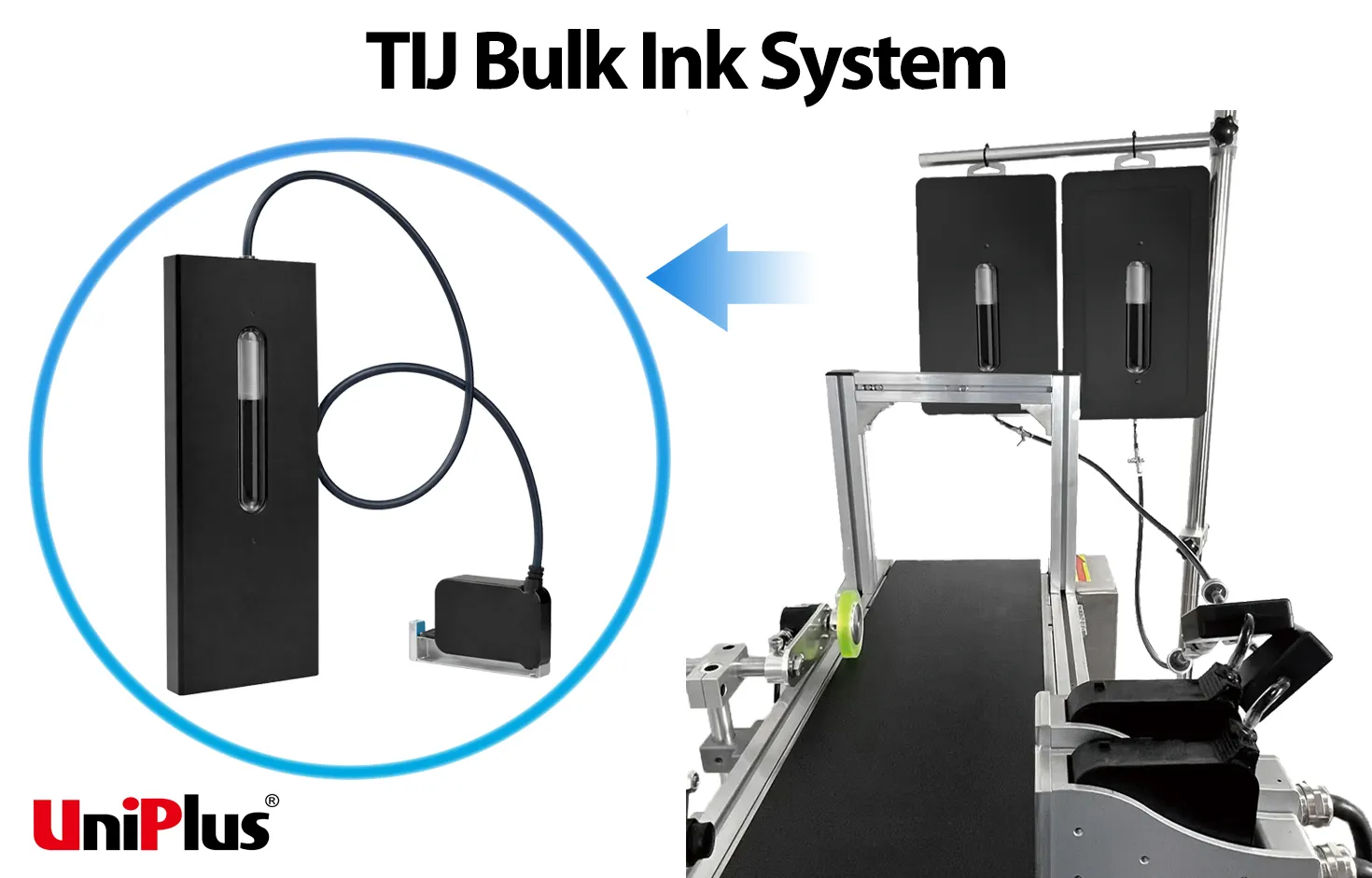
The table below summarises the typical differences. The TIJ column uses HP45-style single-use cartridge TIJ 2.5 as the baseline, which is the architecture the Uniplus product line belongs to; TIJ bulk ink system also exist, where the printhead and ink are separate and behaviour differs. Entries reflect common ranges, and actual results still need to be verified against a specified model, ink type and line condition.
Dimension
TIJ thermal bubble inkjet (TIJ 2.5 cartridge)
CIJ continuous inkjet
System architecture
Printhead and ink integrated into a replaceable cartridge, with no ink recirculation.
Printhead fixed to the equipment, with pump, gutter and fluid recirculation system.
Print quality stability
Some TIJ 2.5 platforms reach 600 dpi class resolution, suiting high-resolution barcodes, QR codes and graphics; actual barcode grade still requires verification.
Droplet diameter is typically larger and typical resolution lower than TIJ; suits small characters, batch numbers and expiry dates.
Uptime stability
Replacing the cartridge renews the printhead, avoiding a fixed printhead accumulating use across multiple consumable cycles; decap time and nozzle deposits still apply during use.
Recirculating supply suits extended continuous running; start-up and printhead cleaning routines are standard, with operator involvement varying by model.
Consumable and fluid management
The cartridge is the main consumable and replacement is straightforward, though wiping or priming may still be needed depending on equipment and ink condition; bulk systems add pressure regulation.
Requires management of ink, make-up fluid and the filter or service module specified for the model; equipment generally monitors or controls ink viscosity and fluid condition automatically.
Routine maintenance
Few items, mostly handled by line operators; simple wiping may still be needed after a cartridge change.
Fluid and recirculation systems need scheduled maintenance; newer models have widely adopted automatic cleaning and operator-performed servicing.
Substrates
Porous, semi-porous and non-porous; solvent inks handle flexible film, foil and PET.
Broad material coverage, particularly strong on curved and irregular surfaces.
Line speed
Supports high-speed lines, though actual speed depends on resolution, message length, printhead configuration and controller capability, and should be tested on a specified model.
Long-established in high-speed continuous small character coding; the two ranges overlap and should not be treated as fixed tiers.
Cost structure
Concentrated in a single consumable, the cartridge, with a relatively simple equipment side.
Spread across ink, make-up fluid and servicing, with a fluid system on the equipment side.
TIJ Stability: Strengths and Limitations
Taking HP45-style single-use cartridge TIJ 2.5 as the example, stability comes from a minimal structural decision: the printhead and ink sit in the same replaceable cartridge. Every cartridge change installs a fresh printhead, which avoids a fixed printhead accumulating use across multiple consumable cycles. With no recirculation lines or filters, the maintenance threshold drops to something a line operator can handle.
Note: From Uniplus’s perspective, TIJ stability should be evaluated based on the specific system architecture, not simply the TIJ technology label. Conventional cartridge-based TIJ typically integrates the printhead and ink supply into a replaceable cartridge, while some bulk ink supply TIJ platforms separate the printhead from the main ink supply and use technologies such as micro-recirculation and automated servicing to extend decap performance and reduce servicing frequency. Therefore, “change the cartridge, change the printhead” is a characteristic of a specific TIJ architecture rather than a universal rule for all TIJ systems.
The limitations worth evaluating:
Decap time: when the nozzle plate is exposed to air without firing, the ink gradually dries. Lines that run intermittently need an ink formulation with strong decap performance, and the gap between platforms can be very large.
Within-cartridge maintenance: dried ink, nozzle deposits or clogging can still develop during use, so simple wiping and priming routines are part of normal operation — it is not maintenance-free.
Print height: a single printhead typically covers 0.5 inch (12.7 mm). Wider print areas can be achieved by stitching multiple printheads, or by moving to a 1 inch (25.4 mm) or wider TIJ printhead.
In some application cases Uniplus has seen, what a customer reports as "TIJ instability" turns out to be a mismatch between ink and substrate — for example water-based ink applied to non-porous plastic film, where poor adhesion causes the code to rub off. When we provide OEM cartridge design and compatibility verification services, we ask customers to send actual substrate for print trials first, so that ink selection rests on measured results rather than specifications.
CIJ Stability: Strengths and Limitations
CIJ stability rests on a mature recirculating supply architecture built for extended, high-speed small character marking. Because ink circulates continuously through the system, CIJ can use more volatile formulations without them drying at the nozzle, which gives it strong adaptability to bottles, curved surfaces and demanding materials. Technical literature notes that CIJ delivers the highest ink throughput among inkjet technologies, at the cost of comparatively limited droplet placement accuracy and a recirculation system that has to handle solvent evaporation and contamination control. It is worth adding that no technology simply never stops — clogging, fluid system condition and environmental factors all affect real availability.
Maintenance and quality points to weigh:
System maintenance cost: ink, make-up fluid and fluid system condition all need managing, along with scheduled replacement of the filter or service module specified for the model. Modern CIJ has extensive automatic cleaning and modular servicing, and routine maintenance on some models can be performed by operators, but scheduled servicing and service costs still belong in the total cost of ownership.
Barcode resolution: where the code includes high-resolution QR codes, linear barcodes or complex graphics, TIJ generally has an advantage in resolution and nozzle arrangement. However, high-resolution CIJ models designed for micro characters and 2D codes are now on the market, so "can it print a QR code" is not a sufficient test — compare actual code dimensions, line speed and verification grade instead.
Once a barcode fails to scan, the cost extends into downstream logistics and customer complaints, so barcode quality should ultimately be judged by verifier results rather than a specification sheet.
Which Production Lines Suit TIJ, and Which Suit CIJ?
Applying those dimensions to real selection decisions makes the logic clear.
Cases where TIJ deserves first consideration:
Codes that include high-resolution barcodes, QR codes, complex graphics or multiple variable data fields.
No dedicated maintenance staff on site, with a preference for clearing print faults by swapping a cartridge.
Lines that switch ink colour or ink type frequently, since there is no fluid circuit to flush.
Multiple lines spread across a site, where simplifying consumables and spare parts matters.
Substrates spanning cartons and labels, or non-porous materials such as flexible film, PET and foil handled with solvent ink.
Cases where CIJ deserves first consideration:
Extended, high-speed continuous lines such as beverage filling or cable extrusion.
Curved surfaces, round bottles or uneven irregular shapes that need a longer throw distance.
Codes limited to simple small character batch numbers and expiry dates.
A need for faster-drying, more volatile ink formulations.
An established maintenance programme or supplier service agreement already in place.
Running different technologies on different lines within the same plant is common and entirely reasonable — for example water-based TIJ on outer cartons and solvent TIJ or CIJ on inner packaging. For a full view of how TIJ compares with other technologies such as TTO and print-and-apply labelling, see our overview article TIJ vs Other Coding Technologies: How to Choose the Right Fit for Your Line.
Further direction usually come up during the decision process:
TIJ 2.5 Industrial Ink Cartridge Selection Support
Back to the core question: which non-contact coding technology is most stable? The answer depends on which risk your line can least afford.
If poor barcode grades, thin maintenance resources or complex consumables are the concern: cartridge-based TIJ has a clear structural advantage.
If extended high-speed running, curved-surface coding or faster-drying ink is the priority: CIJ still holds a position nothing else replaces.
Whichever technology you choose, run a print trial and barcode grade verification with your actual substrate and message content before committing to the purchase.
Uniplus has more than 20 years of experience in thermal bubble inkjet technology, supplying TIJ 2.5 solvent, water-based dye and water-based pigment cartridges in 0.5 inch and 1 inch formats, together with OEM cartridge design and compatibility verification services. If you are evaluating an installation, browse the Uniplus TIJ 2.5 industrial ink cartridge, or contact our technical team to arrange substrate sample testing, and we will base our recommendation on measured results. For a wider view of the trade-offs across coding technologies, return to TIJ vs Other Coding Technologies: How to Choose the Right Fit for Your Line.
Share this article to your friends
Which Non-Contact Coding Technology Is Most Stable? TIJ vs CIJ
Highlights
People searching for the most stable non-contact coding technology have usually been burned on the line already — a barcode that failed to scan and triggered a customer return, a clogged printhead that shut a line down for two hours, or a maintenance schedule that never quite keeps up with actual failures. This article compares TIJ (Thermal Inkjet, also known as thermal bubble inkjet) and CIJ (Continuous Inkjet), the two most common non-contact coding technologies. One thing needs clarifying first: stability is not a single metric. If you are not yet familiar with how TIJ works, start with What Is TIJ Thermal Bubble Inkjet Printing? A Ground-Up Introduction.
What Is Non-Contact Coding? How TIJ and CIJ Are Classified
Non-contact coding means the printing device marks the substrate by projecting ink droplets onto it without touching the product surface. Because no impression mechanism presses against the product, it suits a wide range of product shapes and avoids print quality drifting as mechanical parts wear. That said, whether a given system prints reliably on curved or irregular surfaces still depends on throw distance, droplet flight characteristics and equipment design — it is not a universal property of every non-contact technology. CIJ in particular has a longer working distance, which is why it is so widely used for coding curved and irregular surfaces.
Within inkjet, technologies split into two main branches based on how droplets are generated:
In practical industrial coding selection, TIJ and CIJ are routinely evaluated side by side. That is a solution-level comparison rather than a comparison between peers on the classification tree. For the differences between piezoelectric and thermal bubble mechanisms, see TIJ vs Piezoelectric DOD: How to Choose Between Industrial Inkjet Technologies.
How to Evaluate TIJ and CIJ Coding Stability: Four Key Dimensions
The question that derails most procurement meetings is simply "which one is more stable". When we help customers evaluate a line, we break stability into the following four independent dimensions, each with its own measurable indicator or test method:
These four rarely peak at the same time. Many selection mistakes come from comparing your own strongest dimension against the other technology's weakest.
TIJ vs. CIJ Stability Comparison Table
The table below summarises the typical differences. The TIJ column uses HP45-style single-use cartridge TIJ 2.5 as the baseline, which is the architecture the Uniplus product line belongs to; TIJ bulk ink system also exist, where the printhead and ink are separate and behaviour differs. Entries reflect common ranges, and actual results still need to be verified against a specified model, ink type and line condition.

TIJ Stability: Strengths and Limitations
Taking HP45-style single-use cartridge TIJ 2.5 as the example, stability comes from a minimal structural decision: the printhead and ink sit in the same replaceable cartridge. Every cartridge change installs a fresh printhead, which avoids a fixed printhead accumulating use across multiple consumable cycles. With no recirculation lines or filters, the maintenance threshold drops to something a line operator can handle.
Note: From Uniplus’s perspective, TIJ stability should be evaluated based on the specific system architecture, not simply the TIJ technology label. Conventional cartridge-based TIJ typically integrates the printhead and ink supply into a replaceable cartridge, while some bulk ink supply TIJ platforms separate the printhead from the main ink supply and use technologies such as micro-recirculation and automated servicing to extend decap performance and reduce servicing frequency. Therefore, “change the cartridge, change the printhead” is a characteristic of a specific TIJ architecture rather than a universal rule for all TIJ systems.
The limitations worth evaluating:
In some application cases Uniplus has seen, what a customer reports as "TIJ instability" turns out to be a mismatch between ink and substrate — for example water-based ink applied to non-porous plastic film, where poor adhesion causes the code to rub off. When we provide OEM cartridge design and compatibility verification services, we ask customers to send actual substrate for print trials first, so that ink selection rests on measured results rather than specifications.
CIJ Stability: Strengths and Limitations
CIJ stability rests on a mature recirculating supply architecture built for extended, high-speed small character marking. Because ink circulates continuously through the system, CIJ can use more volatile formulations without them drying at the nozzle, which gives it strong adaptability to bottles, curved surfaces and demanding materials. Technical literature notes that CIJ delivers the highest ink throughput among inkjet technologies, at the cost of comparatively limited droplet placement accuracy and a recirculation system that has to handle solvent evaporation and contamination control. It is worth adding that no technology simply never stops — clogging, fluid system condition and environmental factors all affect real availability.
Maintenance and quality points to weigh:
Once a barcode fails to scan, the cost extends into downstream logistics and customer complaints, so barcode quality should ultimately be judged by verifier results rather than a specification sheet.
Which Production Lines Suit TIJ, and Which Suit CIJ?
Applying those dimensions to real selection decisions makes the logic clear.
Cases where TIJ deserves first consideration:
Cases where CIJ deserves first consideration:
Running different technologies on different lines within the same plant is common and entirely reasonable — for example water-based TIJ on outer cartons and solvent TIJ or CIJ on inner packaging. For a full view of how TIJ compares with other technologies such as TTO and print-and-apply labelling, see our overview article TIJ vs Other Coding Technologies: How to Choose the Right Fit for Your Line.
Further direction usually come up during the decision process:
TIJ 2.5 Industrial Ink Cartridge Selection Support
Back to the core question: which non-contact coding technology is most stable? The answer depends on which risk your line can least afford.
Whichever technology you choose, run a print trial and barcode grade verification with your actual substrate and message content before committing to the purchase.
Uniplus has more than 20 years of experience in thermal bubble inkjet technology, supplying TIJ 2.5 solvent, water-based dye and water-based pigment cartridges in 0.5 inch and 1 inch formats, together with OEM cartridge design and compatibility verification services. If you are evaluating an installation, browse the Uniplus TIJ 2.5 industrial ink cartridge, or contact our technical team to arrange substrate sample testing, and we will base our recommendation on measured results. For a wider view of the trade-offs across coding technologies, return to TIJ vs Other Coding Technologies: How to Choose the Right Fit for Your Line.