12.7 mm is half-inch, 25.4 mm one-inch. Full comparison of print height, capacity, equipment support and GS1 bar height, plus upgrading a half-inch line.
12.7 mm vs 25.4 mm Industrial Ink Cartridges: Half-Inch and One-Inch Explained
For industrial ink cartridges, 12.7 mm and 25.4 mm refer to the maximum vertical print height a thermal inkjet (TIJ) printhead can cover in a single pass. 12.7 mm is the half-inch (0.5") format; 25.4 mm is the one-inch (1"). Both figures are direct inch conversions.
Height is only the starting point. Choosing between the two formats also turns on ink capacity, what the equipment has to support, whether barcode requirements can be met, and whether an existing line needs mechanical work.
The short answer first. Where the print content is a single short code and the line already runs half-inch, half-inch remains the lower-cost choice. But where the marking runs to multiple lines, where a downstream customer sets barcode height requirements, or where new equipment is being specified, the headroom one-inch provides is usually worth having. What follows takes these in the order procurement and engineering teams meet them.
The Difference Between 12.7 mm and 25.4 mm Comes From Printhead Swath Height
Half an inch equals 12.7 mm and one inch equals 25.4 mm. The figure describes the printhead's nominal print swath, meaning the vertical band a printhead covers in one pass. It is not a physical length you could measure segment by segment. One-inch printhead architectures differ in nozzle count and arrangement; what they share is the ceiling on what a single pass can cover.
Print height can be set lower. A character height of 2 mm, 6 mm or 10 mm all sits within a half-inch cartridge's range, with the controller firing only the corresponding section of nozzles.
There is no room to go the other way. Once the content's vertical height exceeds the swath, a single cartridge cannot print it. The options at that point are a larger format or more printheads.
This is the step most often skipped during selection. The "maximum print height" in an equipment datasheet is a ceiling, not a soft limit that parameter changes can push past.
A note on naming. TIJ 2.5 is HP's thermal inkjet cartridge platform, and its documentation defines the printhead size as 12.7 mm, half an inch. HP's wider printhead portfolio includes other swath widths.
"Half-inch and one-inch" is the market's shorthand for two classes of industrial cartridge format, and also how Uniplus classifies its range. It does not mean the TIJ 2.5 specification itself defines two standard sizes. Every height statement below is scoped to these two cartridge formats.
Half-Inch and One-Inch Industrial Cartridges Compared
Taking Uniplus's current solvent-based products as the example, the two formats differ as follows.
Item
Half-inch (0.5")
One-inch (1")
Maximum print height per pass
12.7 mm
25.4 mm
Solvent ink capacity
42 ml
60 ml
Equipment requirement
Suits half-inch TIJ 2.5 systems; assessed case by case per machine model
Requires equipment that supports a one-inch printhead, or corresponding mechanical and control modification
Relationship to HP 45 / 2580 / 2590
A half-inch TIJ 2.5 format; actual compatibility depends on brand, model and firmware version
A separate one-inch industrial format, not a drop-in replacement for half-inch cartridges
Typical print content
Single-line date codes, lot numbers, expiry dates, small barcodes
Multi-line information, large characters, outer-case coding
Headroom
Capped at 12.7 mm; added content means changing format or adding heads
Capped at 25.4 mm; covers everything half-inch can do
When height is exceeded
Move to one-inch, or stitch multiple heads
Stitch multiple heads
The two formats are designed for different equipment architectures. Similar dimensions are no basis for assuming interchangeability. For the wider set of specification dimensions, covering how print height, resolution and cartridge size are weighed together, see the TIJ Specification Selection Guide: Print Height, DPI and Cartridge Size.
Print Content and Line Conditions Suited to Half-Inch 12.7 mm
Where the print content is mainly single-line date codes, lot numbers or expiry dates, and there is no barcode height requirement to meet, half-inch is usually sufficient. Serial numbers and character-based marking have ample room within 12.7 mm.
Barcodes are another matter, and cannot be judged by height alone. Whether a linear or 2D code fits within 12.7 mm has to be calculated from the actual encoded content, working from four variables:
Volume of encoded data: more characters produce a larger symbol.
X-dimension: the width of the narrowest module in the symbol.
Symbol version: the row and column configuration a 2D code resolves to.
Quiet zone: the blank margin that has to stay clear on each side of the symbol.
Where the applicable GS1 application specification sets its own size requirements for that code, the specification governs.
Equipment considerations carry equal weight, for two reasons. A wide range of equipment and consumables is built around a 12.7 mm swath, which makes spare parts and replacements easier to source. And where a line already runs half-inch machines, staying with the same format avoids mechanical modification altogether.
There is a numerical coincidence on the standards side worth explaining, but its conditions have to come first. The GS1 General Specificationsset bar heights for GS1-128 and ITF-14 in General Distribution Scanning, the environment covering warehouse and logistics scanning outside retail point of sale.
Bar height
When it applies
31.75 mm
The standard requirement for General Distribution Scanning
12.70 mm
Permitted only where the trade item or packaging is physically too small for the standard height
5.08 mm
The floor, where space is constrained further still
An equipment limitation cannot stand in for a product size limitation. The provision turns on whether the trade item can carry the standard bar height, not on whether the printer can produce it. A coding printer topping out at 12.7 mm is no reason to apply the reduction.
With that established, comparing 12.7 mm against the GS1 first-stage reduced value of 12.70 mm becomes meaningful. For a small trade item that independently meets the conditions for reduction, a half-inch cartridge's maximum print height can cover that 12.70 mm minimum bar height.
Bar height is not total symbol height. The GS1 figure covers the bars alone. It excludes the human readable interpretation (HRI), the plain-text digits printed alongside the symbol, and for ITF-14 it excludes the bearer bars, the heavy frame printed around the symbol.
So a complete GS1-128 or ITF-14 will not necessarily fit within a single 12.7 mm swath. Where the same cartridge prints the HRI below the symbol, total vertical height exceeds 12.7 mm. Calculate the print height needed from the complete barcode layout, not from the bar height figure.
One more point deserves stating plainly: printing 12.7 mm where the product has room for 31.75 mm is an equipment shortfall, not a compliance approach. Talking it through with downstream trading partners is a necessary commercial step, but a partner's agreement does not turn a non-conforming symbol into a GS1-compliant one.
The limitation of half-inch is that 12.7 mm is a ceiling. Content that fits today will not necessarily fit once a country of origin or traceability code is added. Choosing half-inch locks the maximum at 12.7 mm, and going higher later means changing format or adding printheads.
Print Content and Line Conditions Suited to One-Inch 25.4 mm
There are four reasons to choose one-inch:
Large characters: carton markings that have to be readable from a distance. At any given viewing distance, 25.4 mm allows a far wider range of usable character heights than 12.7 mm.
Multi-line content: product name, lot number, country of origin and traceability code fitting in a single pass.
Fewer stitched heads: in some layouts, one one-inch cartridge replaces two half-inch cartridges stacked one above the other, removing seam alignment and the synchronisation of two printheads, and taking maintenance from two points down to one. That is an architectural simplification; whether downtime or failure rates fall with it still depends on actual line conditions.
Headroom: one-inch covers everything half-inch can do, and the reverse does not hold. A 25.4 mm swath can print 3 mm characters, but a 12.7 mm swath cannot print 20 mm ones, and marking content on most lines grows rather than shrinks.
Barcode height works the same way. 25.4 mm sits 6.35 mm short of the 31.75 mm required for General Distribution Scanning; 12.7 mm sits 19.05 mm short. Both need making up, but one-inch has far less to make up, and stitching to reach the requirement takes fewer printheads.
The cost sits on the equipment side, and divides into two cases:
Upgrading an existing line: moving to one-inch is usually an equipment upgrade rather than a cartridge swap. The machine has to support the corresponding printhead architecture across mechanical mounting, electrical interface, driver and firmware, and layout control.
New equipment: that cost does not arise. Format is settled at the purchase stage, and specifying one-inch requires no modification at all while raising the ceiling from 12.7 mm to 25.4 mm.
25.4 mm Still Falls Short of the GS1 Bar Height Requirement
25.4 mm does not clear that threshold. Where the print content includes an ITF-14 or GS1-128 symbol that must meet GS1 requirements, and the product has room for the standard bar height, a single one-inch cartridge cannot satisfy it directly. Multi-head stitching or an alternative marking method needs assessing. Applicable scanning environments and application specifications vary; refer to the current GS1 General Specifications (at the time of writing, Release 26.0, January 2026).
The purpose behind the bar height requirement is reading efficiency in the actual scanning environment. In explaining height reduction, GS1 notes that the shorter a symbol becomes, the more critical the alignment between symbol and scanning beam, and that height should not be reduced unless necessary. That is the real cost to weigh when choosing print height.
Two separate assessments also need distinguishing.
ISO/IEC 15416
GS1 application specifications
What it governs
Print quality of the symbol as printed
Symbol dimensions and the intended scanning environment
How it is applied
Evaluates quality along multiple scan paths within the inspection band and derives a grade
Sets minimum bar heights and X-dimensions per application
The two are independent. Passing ISO/IEC 15416 verification, currently the 2025 third edition, does not mean the symbol's dimensions meet the applicable GS1 application specification, or the reverse. For more on the relationship between print height and code readability, see Maximum TIJ Print Height: Key Specifications to Know Before Selection.
Confirm the barcode requirement before choosing a cartridge format. From the enquiries Uniplus handles, most "should we move to one-inch" questions turn out to be a mismatch between what a downstream customer's barcode specification demands and what the installed equipment can produce, rather than a height problem. Clarifying the requirement first is generally less work than switching format and correcting afterwards.
A Capacity Difference Is Not a Replacement-Interval Difference
Taking Uniplus's current solvent-based products as the example, the half-inch cartridge holds 42 ml and the one-inch 60 ml. Where print content, character height and coverage are the same, 60 ml does give a longer replacement interval than 42 ml, and fewer changeover stoppages with it.
That condition is the point. Greater capacity does not guarantee a longer interval under every set of conditions, because actual print volume depends on several variables:
Print coverage: solid blocks and bold characters consume far more ink than fine-line text.
Character height and resolution: printing the same content larger increases the number of drops fired.
Length of print content: multi-line information consumes more ink than a single-line date code.
Equipment servicing ink: where equipment has automatic servicing, spitting or purge functions, that ink also counts against usable print volume. On lines with frequent changeovers and stoppages it can materially increase consumption.
If a one-inch cartridge is also being used to print larger characters or graphics, ink consumption per unit of time rises accordingly, and in that case 60 ml will not necessarily outlast 42 ml. Put another way, the capacity advantage is clearest where the print content stays the same and only the format changes; enlarging character height alongside it offsets part of the gain. Comparing operating cost still calls for test data taken under actual printing conditions.
Can 12.7 mm Equipment Be Upgraded to 25.4 mm?
Sometimes, and it depends on the machine. For new equipment the decision ends at which format to specify, and specifying one-inch is usually the safer call. Where machines are already on the line, the first step is confirming that an upgrade path exists at all.
Some equipment switches between 12.7 mm and 25.4 mm by changing the printhead module or the cartridge stall, HP's term for the holder that seats the cartridge, and adjusting system settings. Other equipment has no such flexibility. Interchangeability cannot be assumed, and feasibility should be confirmed with the supplier across three layers:
Mechanical: whether the existing carriage and cartridge stall can take a one-inch printhead module, and whether a factory upgrade kit exists.
Electrical and control: the one-inch cartridge's electrical interface, pin assignment, firing voltage and pulse requirements, and driver architecture, plus whether equipment firmware supports that printhead. A 25.4 mm print height does not by itself imply that the equipment needs more control channels — nozzle count and drive method follow from the printhead architecture, and the actual datasheet has to be checked.
Software and data: whether the controller's layout settings support a 25.4 mm swath, and whether existing print templates need rebuilding.
Chip compatibility is a separate question. Different equipment may use different cartridge identification methods, firmware validation mechanisms or encryption designs. So even on non-encrypted equipment, compatibility cannot be assumed from the "TIJ 2.5" designation alone. It has to be confirmed case by case against equipment brand, model and firmware version.
Uniplus provides compatibility verification services. Where equipment uses an encrypted chip, sending us the machine details lets us assess the available options.
Multi-Head Stitching When Print Height Falls Short
Changing format is not the only answer. Where the required height exceeds a single cartridge's swath, or the equipment does not support a one-inch printhead, multi-head stitching extends coverage another way.
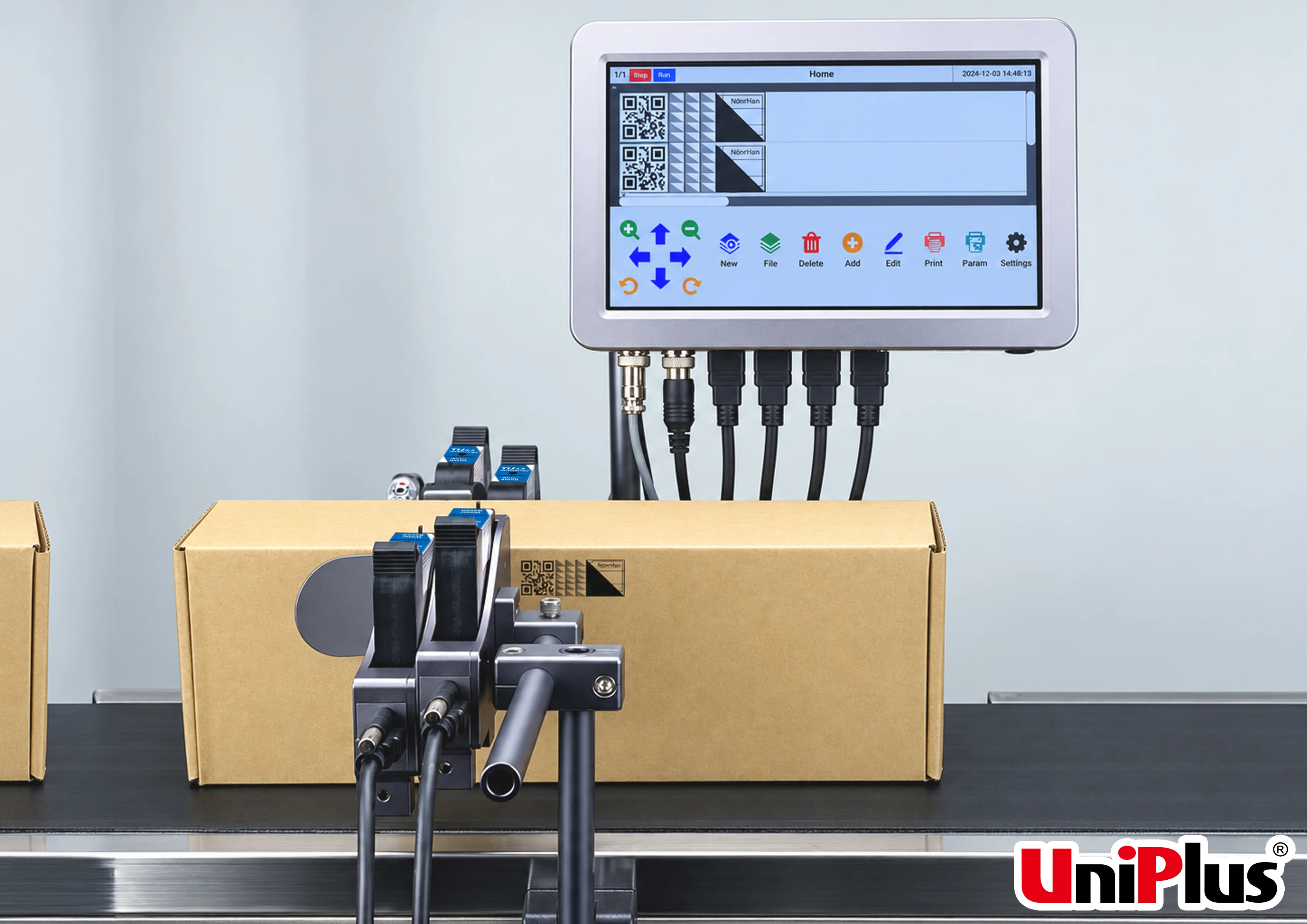
Two or more printheads are arranged vertically, or in staggered mounting (offset slightly along the travel direction so their swaths overlap cleanly). The controller then distributes content across them, joining the individual print swaths into a greater overall height.
Stitching raises a different set of problems from changing format, concentrated in three places:
Mechanical alignment: positional accuracy between printheads.
Synchronisation: how the controller distributes timing signals across heads.
Seam quality: visual continuity where two swaths meet.
Whether those conditions can be met determines whether a stitching solution works on the floor. Which route reaches production faster depends on controller capability, mechanical conditions and how difficult on-site modification proves, so there is no universally applicable answer.
As a rough guide: where the supplier offers an upgrade kit, changing format is usually the simpler path. Where the controller already supports multiple channels and the mechanics have room, stitching turns out to be less work. We will cover the implementation details and synchronisation methods of multi-head stitching in a dedicated article.
The Order in Which to Decide Between Half-Inch and One-Inch
Establish how much vertical space the print content requires, then check whether the equipment is new or already installed. The rule that follows is short:
New equipment: specify one-inch. Format is settled at the purchase stage at no modification cost, and the ceiling rises from 12.7 mm to 25.4 mm. The exception is where marking content is certain to stay within 12.7 mm long term.
Existing half-inch equipment, requirement within 12.7 mm: staying with half-inch is the lower-cost course, with the ceiling now fixed.
Requirement above 12.7 mm: assess one-inch or multi-head stitching.
The full sequence runs as follows.
Inventory the print content: list every field and line to be printed, and measure the vertical height actually required.
Confirm barcode requirements: where the content includes a GS1 symbol, establish the applicable scanning environment and minimum bar height first, and confirm with downstream trading partners.
Inventory the installed equipment: confirm the cartridge sizes supported, how many printheads can be mounted, and the controller's layout and drive capability.
Match substrate and drying conditions: ink type follows from substrate coating, surface energy (how readily ink wets and adheres to the surface), drying time and adhesion requirements together, not from porous versus non-porous alone. This step determines cartridge model rather than size.
Trial print under actual conditions: take samples using the real print content, substrate and line speed, then work back to consumable cost.
Information Worth Preparing Before Enquiring
Having the following ready in one go shortens compatibility confirmation considerably:
Equipment brand and model
A photo or part number of the cartridge currently in use
A sample of the print content, including line count and character height
The substrate to be printed on
Line speed
Any GS1 or customer-side barcode requirements that apply
Send those details to Uniplus and we can assess compatibility and arrange samples. Contact us to start a compatibility check, or browse the industrial TIJ ink cartridge range: the one-inch 60 ml format suits lines needing large characters, multi-line information or fewer stitched heads, while the half-inch 42 ml format answers to existing 12.7 mm systems. The range covers solvent, water-based dye and water-based pigment ink types.
Share this article to your friends
12.7 mm vs 25.4 mm Industrial Ink Cartridges: Half-Inch and One-Inch Explained
Highlights
For industrial ink cartridges, 12.7 mm and 25.4 mm refer to the maximum vertical print height a thermal inkjet (TIJ) printhead can cover in a single pass. 12.7 mm is the half-inch (0.5") format; 25.4 mm is the one-inch (1"). Both figures are direct inch conversions.
Height is only the starting point. Choosing between the two formats also turns on ink capacity, what the equipment has to support, whether barcode requirements can be met, and whether an existing line needs mechanical work.
The short answer first. Where the print content is a single short code and the line already runs half-inch, half-inch remains the lower-cost choice. But where the marking runs to multiple lines, where a downstream customer sets barcode height requirements, or where new equipment is being specified, the headroom one-inch provides is usually worth having. What follows takes these in the order procurement and engineering teams meet them.
The Difference Between 12.7 mm and 25.4 mm Comes From Printhead Swath Height
Half an inch equals 12.7 mm and one inch equals 25.4 mm. The figure describes the printhead's nominal print swath, meaning the vertical band a printhead covers in one pass. It is not a physical length you could measure segment by segment. One-inch printhead architectures differ in nozzle count and arrangement; what they share is the ceiling on what a single pass can cover.
Print height can be set lower. A character height of 2 mm, 6 mm or 10 mm all sits within a half-inch cartridge's range, with the controller firing only the corresponding section of nozzles.
There is no room to go the other way. Once the content's vertical height exceeds the swath, a single cartridge cannot print it. The options at that point are a larger format or more printheads.
This is the step most often skipped during selection. The "maximum print height" in an equipment datasheet is a ceiling, not a soft limit that parameter changes can push past.
A note on naming. TIJ 2.5 is HP's thermal inkjet cartridge platform, and its documentation defines the printhead size as 12.7 mm, half an inch. HP's wider printhead portfolio includes other swath widths.
"Half-inch and one-inch" is the market's shorthand for two classes of industrial cartridge format, and also how Uniplus classifies its range. It does not mean the TIJ 2.5 specification itself defines two standard sizes. Every height statement below is scoped to these two cartridge formats.
For how the printhead, chip and ink inside a cartridge combine to produce that swath, see What's Inside a TIJ Ink Cartridge? Printhead, Chip and Ink Explained.
Half-Inch and One-Inch Industrial Cartridges Compared
Taking Uniplus's current solvent-based products as the example, the two formats differ as follows.
The two formats are designed for different equipment architectures. Similar dimensions are no basis for assuming interchangeability. For the wider set of specification dimensions, covering how print height, resolution and cartridge size are weighed together, see the TIJ Specification Selection Guide: Print Height, DPI and Cartridge Size.
Print Content and Line Conditions Suited to Half-Inch 12.7 mm
Where the print content is mainly single-line date codes, lot numbers or expiry dates, and there is no barcode height requirement to meet, half-inch is usually sufficient. Serial numbers and character-based marking have ample room within 12.7 mm.
Barcodes are another matter, and cannot be judged by height alone. Whether a linear or 2D code fits within 12.7 mm has to be calculated from the actual encoded content, working from four variables:
Where the applicable GS1 application specification sets its own size requirements for that code, the specification governs.
Equipment considerations carry equal weight, for two reasons. A wide range of equipment and consumables is built around a 12.7 mm swath, which makes spare parts and replacements easier to source. And where a line already runs half-inch machines, staying with the same format avoids mechanical modification altogether.
There is a numerical coincidence on the standards side worth explaining, but its conditions have to come first. The GS1 General Specifications set bar heights for GS1-128 and ITF-14 in General Distribution Scanning, the environment covering warehouse and logistics scanning outside retail point of sale.
An equipment limitation cannot stand in for a product size limitation. The provision turns on whether the trade item can carry the standard bar height, not on whether the printer can produce it. A coding printer topping out at 12.7 mm is no reason to apply the reduction.
With that established, comparing 12.7 mm against the GS1 first-stage reduced value of 12.70 mm becomes meaningful. For a small trade item that independently meets the conditions for reduction, a half-inch cartridge's maximum print height can cover that 12.70 mm minimum bar height.
Bar height is not total symbol height. The GS1 figure covers the bars alone. It excludes the human readable interpretation (HRI), the plain-text digits printed alongside the symbol, and for ITF-14 it excludes the bearer bars, the heavy frame printed around the symbol.
So a complete GS1-128 or ITF-14 will not necessarily fit within a single 12.7 mm swath. Where the same cartridge prints the HRI below the symbol, total vertical height exceeds 12.7 mm. Calculate the print height needed from the complete barcode layout, not from the bar height figure.
One more point deserves stating plainly: printing 12.7 mm where the product has room for 31.75 mm is an equipment shortfall, not a compliance approach. Talking it through with downstream trading partners is a necessary commercial step, but a partner's agreement does not turn a non-conforming symbol into a GS1-compliant one.
The limitation of half-inch is that 12.7 mm is a ceiling. Content that fits today will not necessarily fit once a country of origin or traceability code is added. Choosing half-inch locks the maximum at 12.7 mm, and going higher later means changing format or adding printheads.
Print Content and Line Conditions Suited to One-Inch 25.4 mm
There are four reasons to choose one-inch:
Barcode height works the same way. 25.4 mm sits 6.35 mm short of the 31.75 mm required for General Distribution Scanning; 12.7 mm sits 19.05 mm short. Both need making up, but one-inch has far less to make up, and stitching to reach the requirement takes fewer printheads.
The cost sits on the equipment side, and divides into two cases:
25.4 mm Still Falls Short of the GS1 Bar Height Requirement
Moving from 12.7 mm to 25.4 mm does not resolve barcode height on its own. GS1 sets the minimum bar height for ITF-14 and GS1-128 in General Distribution Scanning at 31.75 mm (1.250 inch). Here too only the bars are counted, so the print height a complete layout needs is higher again.
25.4 mm does not clear that threshold. Where the print content includes an ITF-14 or GS1-128 symbol that must meet GS1 requirements, and the product has room for the standard bar height, a single one-inch cartridge cannot satisfy it directly. Multi-head stitching or an alternative marking method needs assessing. Applicable scanning environments and application specifications vary; refer to the current GS1 General Specifications (at the time of writing, Release 26.0, January 2026).
The purpose behind the bar height requirement is reading efficiency in the actual scanning environment. In explaining height reduction, GS1 notes that the shorter a symbol becomes, the more critical the alignment between symbol and scanning beam, and that height should not be reduced unless necessary. That is the real cost to weigh when choosing print height.
Two separate assessments also need distinguishing.
The two are independent. Passing ISO/IEC 15416 verification, currently the 2025 third edition, does not mean the symbol's dimensions meet the applicable GS1 application specification, or the reverse. For more on the relationship between print height and code readability, see Maximum TIJ Print Height: Key Specifications to Know Before Selection.
Confirm the barcode requirement before choosing a cartridge format. From the enquiries Uniplus handles, most "should we move to one-inch" questions turn out to be a mismatch between what a downstream customer's barcode specification demands and what the installed equipment can produce, rather than a height problem. Clarifying the requirement first is generally less work than switching format and correcting afterwards.
A Capacity Difference Is Not a Replacement-Interval Difference
Taking Uniplus's current solvent-based products as the example, the half-inch cartridge holds 42 ml and the one-inch 60 ml. Where print content, character height and coverage are the same, 60 ml does give a longer replacement interval than 42 ml, and fewer changeover stoppages with it.
That condition is the point. Greater capacity does not guarantee a longer interval under every set of conditions, because actual print volume depends on several variables:
If a one-inch cartridge is also being used to print larger characters or graphics, ink consumption per unit of time rises accordingly, and in that case 60 ml will not necessarily outlast 42 ml. Put another way, the capacity advantage is clearest where the print content stays the same and only the format changes; enlarging character height alongside it offsets part of the gain. Comparing operating cost still calls for test data taken under actual printing conditions.
Can 12.7 mm Equipment Be Upgraded to 25.4 mm?
Sometimes, and it depends on the machine. For new equipment the decision ends at which format to specify, and specifying one-inch is usually the safer call. Where machines are already on the line, the first step is confirming that an upgrade path exists at all.
Some equipment switches between 12.7 mm and 25.4 mm by changing the printhead module or the cartridge stall, HP's term for the holder that seats the cartridge, and adjusting system settings. Other equipment has no such flexibility. Interchangeability cannot be assumed, and feasibility should be confirmed with the supplier across three layers:
Chip compatibility is a separate question. Different equipment may use different cartridge identification methods, firmware validation mechanisms or encryption designs. So even on non-encrypted equipment, compatibility cannot be assumed from the "TIJ 2.5" designation alone. It has to be confirmed case by case against equipment brand, model and firmware version.
Uniplus provides compatibility verification services. Where equipment uses an encrypted chip, sending us the machine details lets us assess the available options.
Multi-Head Stitching When Print Height Falls Short
Changing format is not the only answer. Where the required height exceeds a single cartridge's swath, or the equipment does not support a one-inch printhead, multi-head stitching extends coverage another way.

Two or more printheads are arranged vertically, or in staggered mounting (offset slightly along the travel direction so their swaths overlap cleanly). The controller then distributes content across them, joining the individual print swaths into a greater overall height.
Stitching raises a different set of problems from changing format, concentrated in three places:
Whether those conditions can be met determines whether a stitching solution works on the floor. Which route reaches production faster depends on controller capability, mechanical conditions and how difficult on-site modification proves, so there is no universally applicable answer.
As a rough guide: where the supplier offers an upgrade kit, changing format is usually the simpler path. Where the controller already supports multiple channels and the mechanics have room, stitching turns out to be less work. We will cover the implementation details and synchronisation methods of multi-head stitching in a dedicated article.
The Order in Which to Decide Between Half-Inch and One-Inch
Establish how much vertical space the print content requires, then check whether the equipment is new or already installed. The rule that follows is short:
The full sequence runs as follows.
Information Worth Preparing Before Enquiring
Having the following ready in one go shortens compatibility confirmation considerably:
Send those details to Uniplus and we can assess compatibility and arrange samples.
Contact us to start a compatibility check, or browse the industrial TIJ ink cartridge range:
the one-inch 60 ml format suits lines needing large characters, multi-line information or fewer stitched heads, while the half-inch 42 ml format answers to existing 12.7 mm systems. The range covers solvent, water-based dye and water-based pigment ink types.
To work through the specification framework yourself first, start with the TIJ Specification Selection Guide.